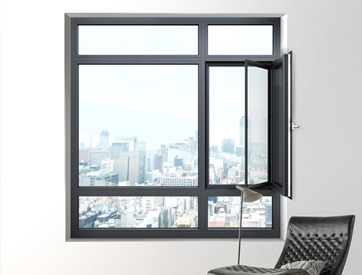
Sliding Gate Supplier in China — Driveway, Aluminum & Automatic Gate Specs
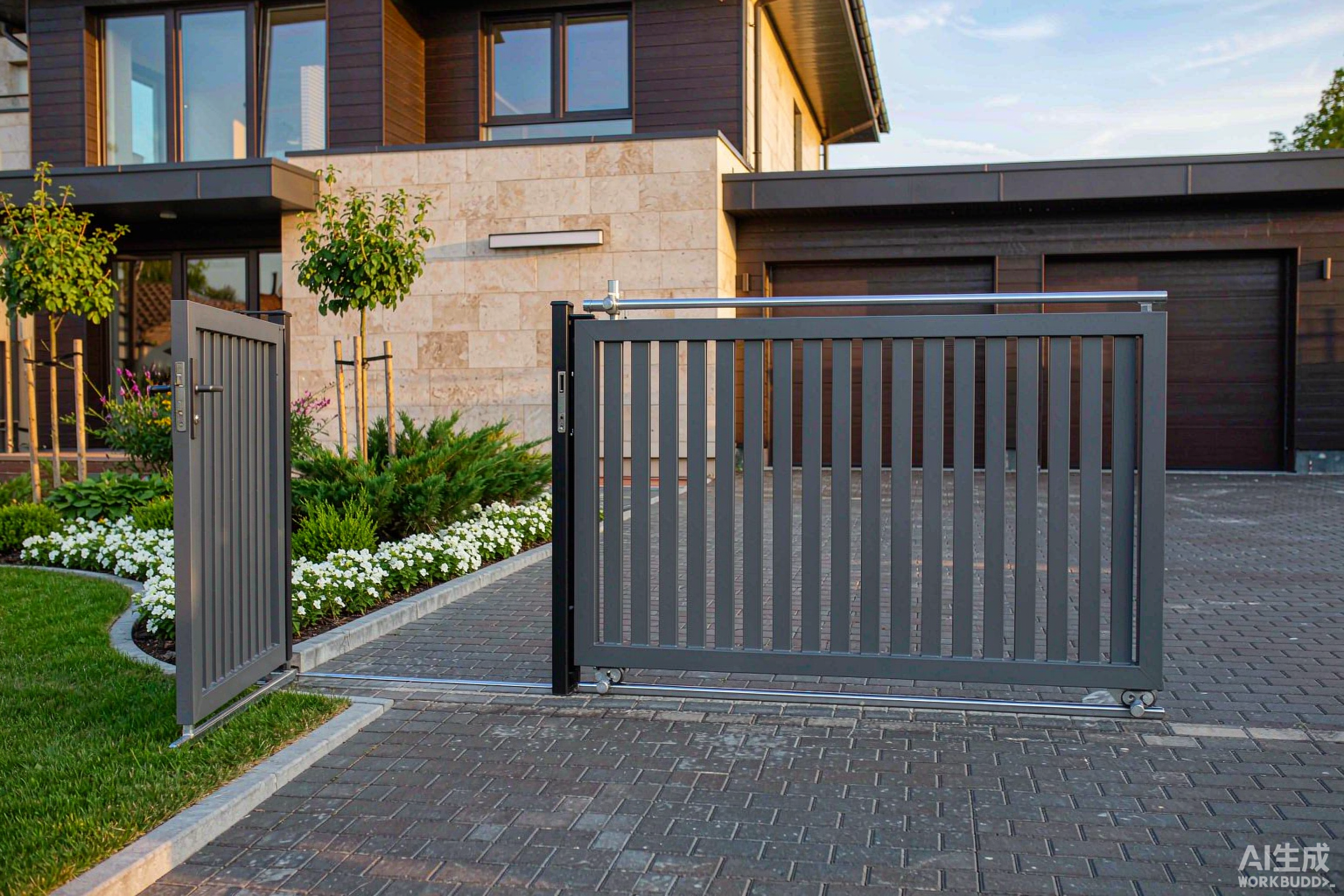
Sliding Gate Supplier in China — Driveway, Aluminum & Automatic Gate Specs
A sliding gate moves horizontally on a ground track or cantilever beam, saving the swing clearance a hinged gate needs. For driveways under 6 m wide, a tracked sliding gate is the lowest-cost option. The same leaf family covers residential villas, gated communities, logistics yards, and factory entrances, with only the wall thickness, infill pattern, and motor class changing between tiers. This page lists the alloy grade, coating parameters, structural data, certifications, procurement terms, and installation steps ROGENILAN supplies from its Foshan production base.
Sliding Gate Price Table (USD, EXW Foshan)
Prices below are EXW Foshan, 2026 production batch, single-leaf tracked design, powder-coated aluminum, excluding motor and shipping. Add 12–18% for a matching pedestrian wicket door.
Standard single-leaf sliding gate pricing by width
For widths up to 5 m a single leaf on two fixed posts is standard. Above 5 m, leaf deflection under wind load grows, so wall thickness steps up from 2.0 mm to 2.5 mm and the price band shifts up by 10–15%. The unit price per square metre falls as leaf area rises because cutting and jig setup are fixed per leaf, so a 6 m leaf costs less per m² than a 3 m leaf even though the absolute total is higher. For distributor orders above 50 leaves in one shipment, the EXW band drops a further 6–9% through shared anodizing and powder batches.
Powder-coating and hardware add-ons
Standard color (matte black, grey 7016, white 9016) is included. Custom RAL colors add USD 6–10/m². Stainless 304 track and sealed rollers add USD 40–70 per leaf. A 24V brushless motor adds USD 180–320 depending on leaf weight. Optional photoelectric photocells, warning light, and a backup battery add USD 35–90. For coastal sites within 500 m of the shoreline, specify 316-grade stainless track hardware at +USD 25 per leaf to resist chloride corrosion over the 10-year service window.
Aluminum Sliding Gate — Alloy Grade and Coating Process
The aluminum sliding gate body uses extruded 6063-T5 alloy. This tempers to 160–205 MPa tensile strength while staying formable for slender slats. Frame and infill are separate extrusions joined by stainless screws, not welding, so coating is uniform. A finished 4 m leaf weighs 38–46 kg, roughly 60% less than an equivalent steel gate, which lowers the track and motor load and simplifies on-site handling by two installers.
Aluminum alloy 6063-T5 and profile wall thickness
Main frame extrusion wall thickness is 2.0 mm for leaves under 5 m and 2.5 mm above. Posts use 3.0 mm square tube 100×100 mm embedded 500 mm into concrete. Tolerance on cut length is ±1.5 mm.
Powder coating parameters
Profile passes a 9-stage pre-treatment (degrease, chromate-free conversion coating), then polyester powder is applied on a Nordson line to 60–80 µm film thickness and cured at 200 °C for 10 minutes. Adhesion passes ISO 2409 cross-cut class 0. Salt spray resistance is 1,000 h per ASTM B117.
Thermal break strip and water management
Slatted infill uses a PA66GF25 thermal break strip 14–24 mm wide to reduce heat transfer at the post cap. Weep holes at 300 mm spacing drain the bottom rail. The strip is not structural; it separates interior and exterior aluminum to cut condensation. Inbound extrusions contain 60–75% post-industrial recycled aluminum, lowering the leaf carbon footprint without changing the 6063 mechanical spec. Recycled content is documented in the mill certificate so distributors can answer ESG tenders.
Driveway Gate — Wind Load and Structural Specs
A driveway gate faces direct wind once the property is open. ROGENILAN rates tracked leaves to 1.5 kN/m² (≈ class 5 per EN 12400), adequate for most inland and suburban coastal sites.
Wind load rating
Static pressure test: leaf held at 1.5 kN/m² for 10 s with ≤25 mm deflection at mid-span. For exposed coastal sites above 2.0 kN/m², specify 2.5 mm wall and reduced slat open area to 35%. Foundation bolts are M16 galvanized at 400 mm spacing into the post footing, each rated 12 kN pull-out in C25 concrete. A partial-open mode (leaf parked 30% open) is available on automatic units to keep airflow during storms while limiting sail area.
Track and roller load capacity
Ground track is stainless 304, 50×50 mm, rated 800 kg. Two sealed rollers per leaf carry up to 400 kg each. Cantilever versions replace the ground track with a 4-wheel bogie on a support beam for sites where a flush track is impractical.
Modern Sliding Gate Designs for Homes
Modern sliding gate designs for homes balance privacy and sightlines. Three infill families cover most villa and townhouse entrances.
Vertical slat, frosted glass insert, and laser-cut panel options
Vertical slat (40 mm pitch, 50% open) is the default for airflow and lower wind load. Frosted tempered glass inserts (5 mm, 1.2 m wide band) add a light entry without full transparency. Laser-cut 3 mm aluminum panels carry custom patterns at +USD 12–20/m².
Pedestrian wicket door and intercom integration
A 0.9 m wicket door in the leaf lets residents walk out without opening the full gate. Two pre-drilled 25 mm conduits route the intercom and magnetic lock wiring through the frame during assembly, avoiding on-site drilling. Custom laser-cut patterns carry a one-time tooling fee of USD 120–200 and a 7-day sampling lead; repeat orders reuse the tool at no cost. Wicket doors accept a Euro-profile cylinder and a standard 20 mm multi-point latch.
Aluminum Gate Certifications
Every aluminum gate leaves the factory with documented compliance for export markets.
CE marking, ISO 9001, AAMA 2604/2605
Products carry CE marking under EN 13241-1 (industrial, commercial and garage doors). The plant holds ISO 9001:2015. Coating meets AAMA 2604 (South China, 5-year chalk/fade) and AAMA 2605 (premium, 10-year) on request. Each batch ships with a mill certificate and coating thickness report.
Miami-Dade NOA and NFRC where applicable
For the U.S. hurricane zone, the leaf kit is supplied to Miami-Dade NOA acceptance where the local dealer submits the application; impact-rated glazing and reinforced posts are specified separately. NFRC U-factor and SHGC labels apply to any glazed insert, typically U ≤ 5.7 W/m²K for the insert assembly. An in-house test bay runs cycle testing to 20,000 open-close cycles and salt-spray to 1,000 h, so distributors receive a per-batch report rather than a generic certificate.
Procurement — MOQ, Lead Time, Payment, Packaging
Export terms are standardized to reduce onboarding time for distributors.
MOQ and production lead time
Minimum order is 5 leaves per design. Standard production is 18–25 working days after drawing confirmation; 30–35 days for laser-cut or custom RAL. Sea freight lead time is additional and quoted per destination port.
Payment terms and export packaging
Terms are 30% T/T deposit, 70% before container loading, or irrevocable L/C at sight for orders above USD 20,000. Each leaf is wrapped in PE foam, cornered with cardboard, and crated in plywood at 20 leaves per crate (≈ 1.1 CBM, 320 kg). A spare-parts kit—two rollers, one limit switch, and a remote handset—ships free inside the crate for every 10 leaves ordered, cutting post-sale downtime for the distributor’s service team.
Installation — Track, Waterproofing, Commissioning
Tracked gates fail most often from poor foundation, not from the leaf. Follow the steps below.
Ground track alignment and concrete foundation
Pour a 150 mm reinforced concrete beam along the track line, level to ±3 mm over the full run. Set the stainless track on the cured beam with expansion anchors at 600 mm spacing. Check track straightness with a string line before bolting.
Weather sealing and motor commissioning
Fit EPDM bottom brush to the leaf base to block drafts and debris. Mount the 24V motor to the end post, align the rack, and set open/close limits. Test obstacle reverse at 50 N force per EN 12453. Apply anti-seize to rollers at 6-month intervals. A sloped track channel with a 10 mm fall per metre drains rainwater away from the roller path, preventing the winter ice lock that disables ground-track gates in cold climates.
Customer Case — Villa Driveway, Foshan
A 2025 residential project replaced a swing gate with a tracked sliding gate.
Project data
Site: Foshan villa, opening 4.8 m, height 1.8 m. Configuration: 6063-T5 2.0 mm slat leaf, grey 7016, wicket door, 24V motor. Area of aluminum: 8.6 m². Delivered price: USD 1,020 EXW, installed locally for USD 240.
Cost and function comparison
The previous swing gate needed 5.2 m of clear sidewalk — impossible on the narrow plot. The sliding gate recovered 11 m² of usable frontage. Versus a cantilever gate, the tracked version saved USD 310 on hardware for the same span. Two-year maintenance was limited to one roller lubrication and one remote battery swap, with no track realignment needed because the concrete beam was poured to the ±3 mm spec during the build.
Configuration Comparison Table
Pick the build that matches the site constraint.
Manual vs. automatic
Manual tracked gates suit seasonal or low-traffic entrances. Automatic adds a motor, rack, photocells, and a controller; budget USD 180–320 for the drive plus USD 40 for safety edges.
Single vs. telescopic double-leaf
Openings above 6 m exceed a single leaf’s deflection limit. A telescopic two-leaf folds to half the parking length but costs 30–40% more and needs a deeper track run. Specify telescopic only when the run-on space is under 60% of the opening.
Sliding vs. swing — specification rule
Choose a sliding gate when the frontage has less than 4 m of clear pavement on the opening side, or when the driveway slopes, because a swing leaf needs a flat arc with no grade change. Choose a swing gate only when the opening exceeds 7 m and a cantilever sliding leaf becomes uneconomic. For shared community entrances with 200+ daily cycles, spec the automatic tracked version with a brushless motor rated 100,000 cycles rather than the 30,000-cycle economy unit.
Related reading: Doors Supplier in China — Types, Pricing & Technical Specifications, Aluminum Door Factory in China — Sliding, Garage & Entrance Door Specs, and Doors for Houses Wholesale in China — Aluminum Door Specs & Pricing.