Wooden Door Wholesale in China | Wood Grain Aluminum Doors for House, Specs & Pricing
Most orders labelled “wooden door” leaving Guangdong today are not solid timber. They are 6063-T5 aluminium profiles carrying a wood-grain transfer film or a wood-veneer clad face, because solid timber loses dimensional stability above 75% RH and fails the 168-hour salt-spray requirement that Middle East and coastal US buyers now write into contracts. This page lists the alloy data, coating parameters, U-values, price tables and procurement terms our Foshan plant quotes for both routes, so you can compare on numbers instead of on photographs.
Wooden Door Construction: Wood Grain Aluminium vs Solid Timber
Alloy Grade, Wall Thickness and Frame Depth
Every wooden door frame we extrude uses 6063-T5 aluminium, tensile strength 205 MPa minimum, yield 170 MPa, elongation 8%. Wall thickness is not negotiable by price tier — it is set by leaf size:
Solid timber equivalents in the same openings use 45-55 mm engineered stile-and-rail cores (finger-jointed pine or meranti) with a 4 mm veneer face. Core moisture content is dried to 8-12%. Above 1200 mm leaf width we stop quoting solid timber for exterior use: measured warp on a 1400 mm meranti leaf after 12 months in Jeddah reached 6.5 mm, against 0.8 mm on the aluminium equivalent.
Wood Transfer Coating Process Parameters
The wood grain is not paint. Sequence and controlled values:
- Degrease at 45-55 degC, alkaline bath, 4 minutes
- Chromium-free conversion coat, film weight 20-30 mg/m2
- Polyester powder base coat, electrostatic, 60-80 micron dry film
- Cure 200 degC x 20 minutes
- Wood-grain film vacuum transfer, 190 degC x 3.5 minutes, film wrap tension 3.5 N/mm
- Second cure and cool
Result data: total coating 90-120 micron, pencil hardness 2H, adhesion ISO 2409 grade 0, QUV accelerated weathering 2000 hours with delta-E under 3.0, salt spray 1000 hours with no blistering. Anodised and fluorocarbon (PVDF 3-coat, 40 micron) options exist but the wood effect is only achievable on the powder + transfer route.
Thermal Break Strip Material and Width
Exterior wooden doors use PA66 GF25 polyamide strips, not PVC. Widths available 14.8 mm, 20 mm, 24 mm and 34 mm. Shear strength after the standard 6-cycle thermal test stays above 24 N/mm. The choice drives the U-value directly, shown in the comparison table further down. For a full breakdown of our profile systems across product families see our aluminium door factory specifications.
Wooden Door Price Tables: FOB China, USD
Exterior Wood Grain Aluminium Doors
What Moves the Unit Price
Ranges above are driven by five measurable variables, in order of cost weight: glass build-up (Low-E soft coat adds 14-22 USD/sqm over clear; argon fill adds 6-9), hardware brand (Chinese OEM multipoint lock 28-45 USD, German brand 95-160 USD), thermal break width (20 mm to 34 mm adds 11-18 USD/sqm), coating route (PVDF adds 18-26 USD/sqm over powder + transfer), and order quantity. Volume steps are real, not rhetorical:
Comparable pricing logic across other door families is set out in our doors for houses wholesale price tables.
Wooden Doors for House: Exterior Entry Configurations
Opening Types and Structural Limits
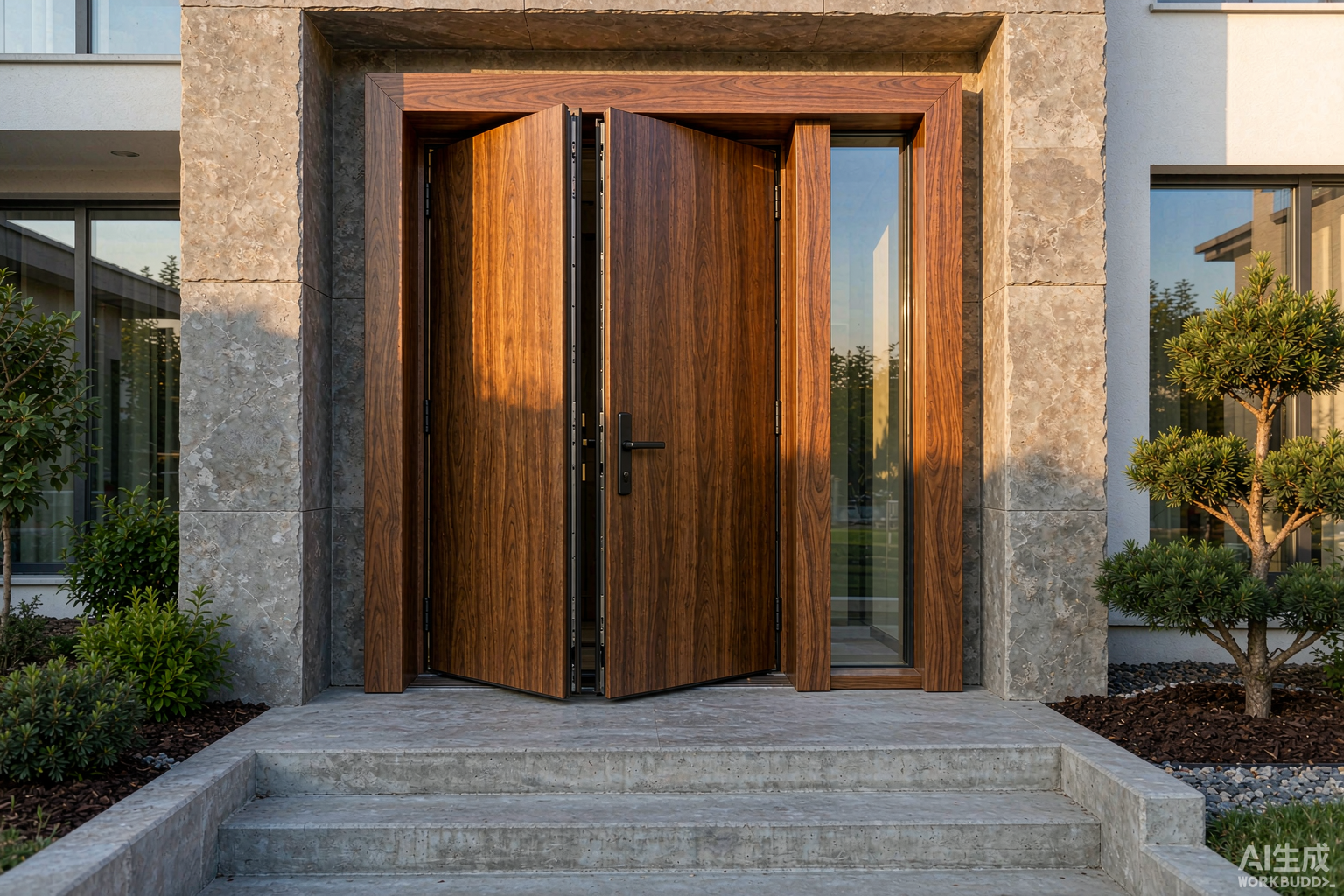
Wooden doors for house entrances split into four mechanical types with fixed geometric ceilings. Single swing tops out at 1200 x 2600 mm before hinge deflection exceeds 3 mm at the lock stile. Double leaf goes to 2400 x 2800 mm total. Floor-pivot doors reach 1800 x 3200 mm because load transfers to the slab, not the jamb. Sliding wood-grain leaves run to 2000 x 2600 mm per panel on a 2 x 40 mm stainless track.
Performance Data Delivered on Entry Sets
Buyers replacing timber entry sets normally cross-shop our entry door wholesale specifications before fixing the configuration.
House Door Wood Finishes: Grain Options and Weathering Data
Available Grain Codes
Twenty-two transfer films are held in stock. The eight moved most often for house door wood orders, with measured colour retention after 2000 hours QUV:
Maintenance Interval Data
Solid timber exterior doors need re-oiling or re-coating every 18-36 months depending on UV exposure; measured film loss on a south-facing meranti leaf in Dubai reached 40% of original coating thickness in 22 months. Wood-grain aluminium requires washing only — neutral detergent, pH 6-8, twice yearly. Warranty terms follow that gap: 10 years on the transfer coating, 2 years on timber finishes.
Solid Wood Interior Doors Prehung vs Aluminium Prehung Units
Prehung Assembly Tolerances
A prehung unit ships as leaf, frame, hinges and strike already fitted and shimmed. Our tolerance set: frame diagonal deviation under 1.5 mm, reveal gap 3 mm +/- 0.5 mm on all three sides, bottom clearance 8-10 mm. Solid wood interior doors prehung from timber mills typically ship at 3 mm diagonal deviation because the core moves in transit; aluminium units hold the factory value through a 40-day sea leg.
Cost and Weight Comparison, Interior Openings
Bathroom and wet-area openings are the clearest case for the aluminium route — the data sits in our interior doors factory specifications.
Wood Garage Door Panels: Sectional and Sliding Data
Sectional Panel Build-Up
A wood garage door in wood-grain aluminium is a sandwich panel: 0.5 mm pre-coated aluminium skin, 40 mm CFC-free polyurethane core at 42 kg/m3, 0.5 mm inner skin. Panel U-value 0.52 W/m2K, panel-level; full door assembly with frame and seals lands at 1.35-1.55 W/m2K. Section height 500 mm or 610 mm. Torsion spring rated 25,000 cycles standard, 100,000 cycles on request.
Wood Garage Door Price and Drive Options
Insulated and glazed variants across sizes are tabulated in our garage door specification and pricing tables.
Certifications and Test Reports Issued
Certificate List
- CE marking to EN 14351-1 for external pedestrian doorsets
- ISO 9001:2015 quality system, ISO 14001:2015 environmental
- NFRC certified simulation and CPD listing for U-factor, SHGC, VT on glazed leaves
- AAMA/WDMA/CSA 101/I.S.2/A440 performance class LC-PG50
- Miami-Dade County NOA for large-missile impact configurations (laminated 6+1.52PVB+6 minimum)
- ASTM E283 air, E331 water, E330 structural test reports
- AS 2047 for Australian market entry sets
- SGS material report on coating thickness, adhesion and heavy metal content (RoHS)
What Buyers Should Request in Writing
Ask for the test report number, the test laboratory name, the tested specimen size and the date. A certificate that does not state specimen dimensions is not transferable to your opening size — a Class C5 result on a 1000 x 2100 specimen does not carry to a 1800 x 3000 door. We issue reports with specimen drawings attached.
Procurement Terms: MOQ, Lead Time, Payment, Packing
Commercial Terms
Packing Specification
Each leaf: PE protective film on all coated faces, 5 mm EPE foam wrap, corner protectors, then 5-layer corrugated carton. Frames bundled with steel strapping on plywood pallets, fumigation-free (ISPM 15 exempt engineered wood). Loading data: 20GP holds 130-160 sqm of swing door sets; 40HQ holds 300-360 sqm. Container photos and packing list issued before balance payment.
Installation and Waterproofing Sequence
Step Sequence for Exterior Wooden Doors
- Check opening: structural dimension = frame size + 20 mm per side, diagonal deviation under 5 mm
- Set frame with expansion bolts M8 x 100, spacing 400-500 mm, first fixing within 150 mm of each corner
- Level and plumb to 1 mm/m; shim with plastic packers only, no timber wedges left in place
- Fill perimeter cavity with low-expansion PU foam, 70% fill, allow 30 minutes cure
- Trim foam flush, apply waterproof membrane tape 100 mm wide over the joint, lapped onto the wall face
- Apply neutral cure silicone, modulus 25LM, joint width 8-12 mm with backer rod on joints over 10 mm
- Install threshold with a 5 mm slope outward and a continuous bed of butyl under the sill
- Fit leaf, adjust hinges to a uniform 3 mm reveal, test lock engagement at all points
Commissioning Checks
Water-test the sill with a hose at 3 bar for 5 minutes before internal finishes go on — leaks found later cost 8-15 times more to correct. Verify closing force under 60 N at the handle, self-closing time 4-6 seconds on units with a closer, and confirm the multipoint lock throws all points with the leaf in the closed position, not while held open.
Project Case Data
Villa Cluster, Riyadh, Saudi Arabia
Scope: 48 villas, 96 main entry leaves at 1200 x 2600 mm, WG-101 golden teak, 24 mm PA66 break, 6+12Ar+6 Low-E vision lite, German multipoint locks. Contracted value USD 142,600, delivered in two 40HQ containers, 41 days production. The client’s previous timber package on an earlier phase cost USD 118,000 but incurred USD 31,400 in re-coating and 7 leaf replacements inside 26 months. Net cost over 3 years favoured aluminium by 9.4%.
Residential Development, Melbourne, Australia
Scope: 112 units, mixed package — 112 entry doors (WG-508 matt walnut) plus 224 interior prehung leaves. AS 2047 compliance required, wind class N3. Entry doors tested to 1500 Pa serviceability. Order value USD 214,800, FOB Guangzhou, 52 days. Interior prehung units shipped at 1.7 cbm per 20 leaves, saving 29% container space against the timber quotation the developer held.
Single House Retrofit, Houston, USA
Scope: 1 pivot door 1400 x 2800 mm, WG-114 walnut, 34 mm break, laminated impact glass to Miami-Dade NOA. Unit price USD 1,465 FOB, air-freight sample first at USD 310. Measured post-install blower door result on the doorway: 0.41 m3/h.m2 at 50 Pa.
Configuration Comparison: Which Build to Specify
Performance by Build-Up
Selection Rules by Climate
Hot-arid markets (GCC, North Africa): prioritise SHGC under 0.30 and 24 mm minimum break; grain colour in mid tones, since dark films run 12-18 degC hotter on the surface and accelerate seal ageing. Cold markets (North Europe, Canada): 34 mm break, argon fill, Ud target under 1.6. Hurricane zones (Florida, Caribbean): laminated glass with a Miami-Dade NOA reference is mandatory, not optional. Tropical humid markets: aluminium only for exterior — timber swelling data above makes the case. The full product range and category-level pricing structure is indexed on our doors supplier technical and pricing page.
Request a Quotation
Information Needed for a Firm Price
Send: opening sizes (structural, width x height), quantity per size, opening direction, grain code or a colour sample, glass requirement, hardware preference or brand, target certification, destination port and trade term. With those eight items we return a firm FOB price and a signed lead time inside 24 working hours. Without sizes and quantity, any figure quoted is an estimate only.
Sample Policy
Corner samples (300 x 300 mm profile assembly with grain finish, break strip and glass edge) ship free by courier on collect terms. Full-size door samples are charged at list price and credited against the first production order above 100 sqm.