Outdoor Furniture Wholesaler in China: Aluminium Pergola Frames, Glass Room Packages and FOB Pricing
2. Seat and Table Load Capacity
3. Pergola Outdoor Structures
4. Glass Room Outdoor Enclosures
5. Garden House Outdoor Specifications
6. Alloy and Temper Selection
7. Surface Treatment and Corrosion
8. Colour and Touch Temperature
9. Textiles, Mesh and Cushion Drying
10. Stability and Test Standards
11. Production Process
12. FOB Price Tables (USD)
13. MOQ, Lead Time and Payment
14. Container Loading and Landed Cost
15. Assembly, Care and Failure Points
16. Project Case Data
17. Material Comparison and Selection
18. RFQ Checklist
19. Related Products
20. Glossary and Standards Index
Aluminium Outdoor Furniture Frames – Section Properties and Tube Selection
An aluminium outdoor furniture frame is a set of rectangular tubes in bending. Selection starts from the second moment of area I (mm4) and the section modulus W (mm3), not from the catalogue photograph. I controls deflection under load; W controls bending stress. Because the elastic modulus of every aluminium alloy is the same – 70,000 MPa – changing alloy never changes how much a frame sags. Only geometry does.
Section Geometry and What Each Number Controls
- I (second moment of area) – stiffness. Doubling the depth of a tube at constant wall thickness raises I roughly eightfold, because I scales with the cube of depth for a thin-walled section.
- W (section modulus) – strength. Bending stress = M / W, where M is the applied moment in N.mm.
- A (area) – mass and cost. Mass per metre = A x 2,700 kg/m3. Aluminium tube at 1.04 kg/m costs roughly three times as much as steel tube of identical section, which is why wall thickness is the first place a low quotation is cut.
- i (radius of gyration) – buckling of legs and posts. Slender chair legs and 3 m pergola posts are checked with i, not with W.
Section Property Table – Furniture and Pergola Tubes
The F-series is the furniture family; the P-series is the pergola family. Both come off the same extrusion press and the same powder line, which is why a factory that produces aluminium windows and doors can produce outdoor furniture at a competitive price: billet, die, coating and packing assets are shared.
Wall Thickness, Denting and Local Buckling
Thin-wall tubes in bending fail by local buckling of the compression face long before the material reaches its yield stress. Practical minimums used in export production:
- 1.2 mm – decorative trim only; not used for load-bearing members. Dents at 40 N point load.
- 1.5 mm – chair legs, armrest supports, cross rails. Acceptable for domestic seating.
- 2.0 mm – seat front rails, sofa base frames, table legs. The default for contract-grade outdoor furniture.
- 2.5-3.0 mm – bench beams, lounger frames, pergola purlins and posts.
Seat and Table Load Capacity – What One Tube Actually Carries
A seat platform is a set of parallel or perimeter tubes carrying a distributed load. The model below treats a single rail as a simply supported beam under a uniformly distributed load, with two limits: bending stress not exceeding Rp0.2 / γM1 (170 / 1.10 = 154.5 MPa for 6063-T6, per EN 1999-1-1) and mid-span deflection not exceeding L/200. The reported figure is the total load the rail can carry, in kg.
Deflection Governs, Not Strength
In every section and span in the table the deflection limit is reached first. For 6063-T6 tubes the stress limit would allow roughly 3 to 6 times more load than the L/200 deflection limit permits. This has a direct purchasing consequence: specifying a higher-strength alloy does not make a sofa stiffer. Only a deeper or thicker tube does, or an extra support.
Read the table as a design tool. A 50 x 50 x 2.0 mm front rail spanning 1,500 mm carries 180 kg before it has sagged 7.5 mm. That is one heavy occupant, not three, which is why a three-seat sofa never uses a single unsupported front rail.
Adding One Cross-Member – the Cheapest Stiffness on the Market
Halving the span with a single intermediate cross-member multiplies the distributed load capacity by about four (capacity scales with 1/L2 once the deflection limit is written as L/200). The table gives the capacity of the same section at half span.
A 25 x 25 x 1.5 mm cross-member costs under $2 of tube and 40 seconds of welding. Moving from F1 to F6 to achieve the same capacity costs about three times the mass and roughly $9-14 per frame. The cross-member is always the cheaper answer, and it is the single most common difference between a frame that passes a contract durability test and one that does not.
Welded Frames – HAZ Softening Costs Nothing Here
Welding 6063-T6 reduces the yield strength in the heat-affected zone to roughly the T4 condition, about 70 MPa. With γM1 = 1.10 the allowable stress in the HAZ drops to 64 MPa, so the bending-strength capacity of the joint falls to about 41% of the unwelded value. But the elastic modulus is unchanged, so the deflection capacity is unchanged – and deflection is the governing limit.
The practical conclusion: on furniture frames, a welded joint is not the weak point unless the section is very deep and the span very short. Where welding does matter is at the leg-to-rail node under a horizontal racking load, and on pergola rafter-to-post connections. Those joints should be checked separately with a fillet weld throat calculation, and on exposed frames the weld should be ground and re-coated because the weld zone is where coating adhesion fails first.
Related: the same section-selection logic applies to our aluminium pergola and gazebo systems, which use the P-series tubes documented below.
Pergola Outdoor – Aluminium Pergola Structure, Snow and Uplift
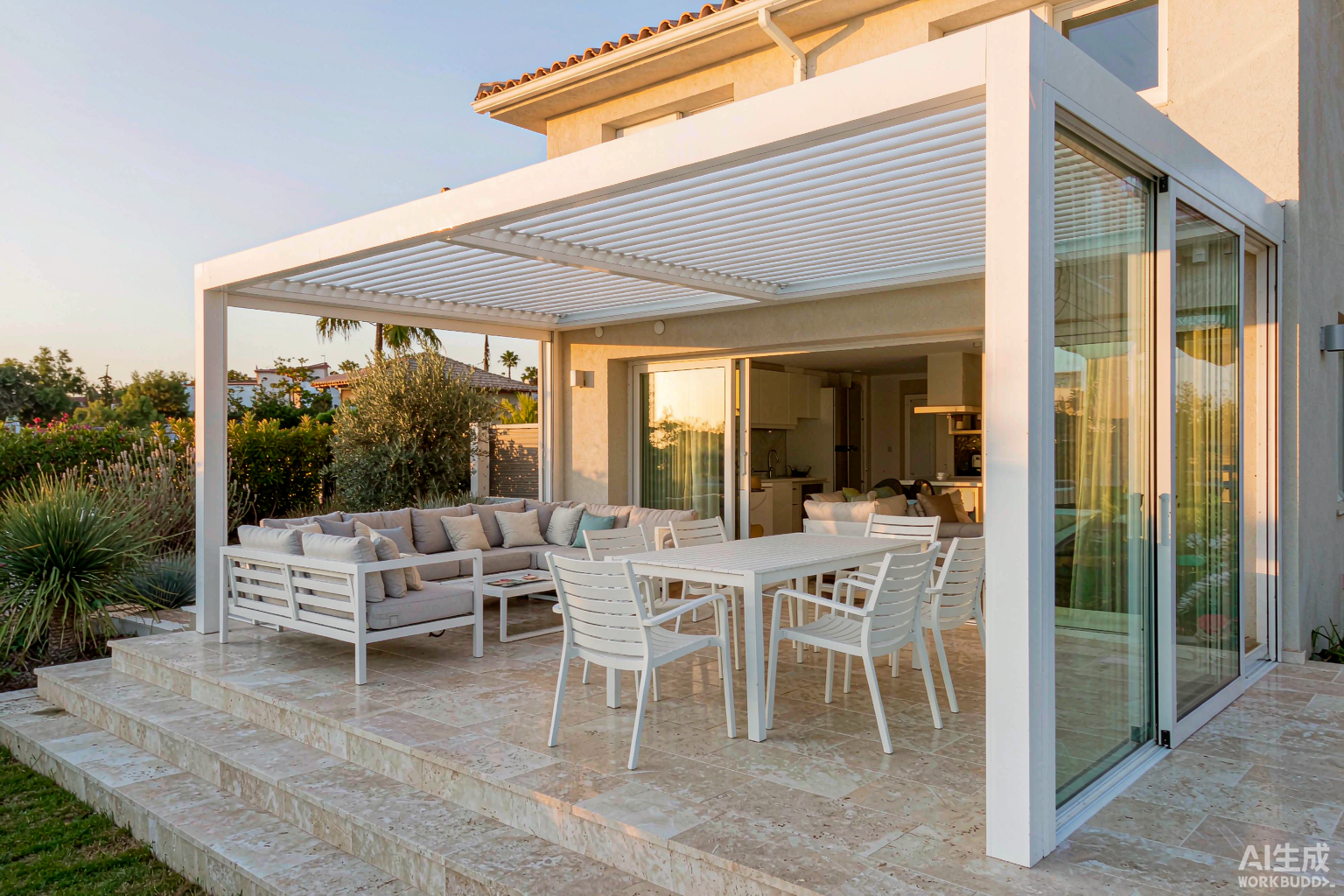
A pergola outdoor structure is the same product family as the furniture underneath it: extruded tube, powder-coated, mechanically jointed. The difference is that a pergola carries snow, wind uplift and its own roof mechanism, so the member sizes are checked against EN 1991 and EN 1999 rather than against a seating test. An aluminium pergola with a louvre roof is the fastest-growing SKU in this category because it converts a terrace into a usable room without a building permit in most jurisdictions. In US spelling the same product is written aluminum pergola; the engineering below applies to both, and the section labels P1-P6 are used throughout this article.
Rafter Span by Snow Zone
The model uses closed louvres carrying their own dead load of 0.20 kN/m2 (blades plus drive mechanism) plus the characteristic snow load sk on ground, at 600 mm rafter centres, simply supported, deflection limited to L/200. Values are the maximum clear span in mm.
Deflection governs in all four zones, as it does for the furniture frames. A 3 m clear span is comfortable with P2 in every zone; a 4 m span needs P5 or an intermediate beam. Note that a louvre roof has two states: closed louvres collect the full snow load, and open louvres collect almost none but are then exposed to the full wind-uplift case. Both states must be checked, and the roof controller must be specified to open the louvres automatically on a snow or wind signal if the site is unattended in winter.
Posts – Buckling Is Rarely the Problem
Pergola posts are short and stocky. The table gives the design axial resistance (minimum of Euler buckling and squash, divided by γM1) in kN for pin-ended posts.
Even in the alpine zone the demand on a 3.6 m post is under 10 kN against a resistance of 44 kN from the smallest section in the table. The post is never the governing member. What governs is the rafter span, the base-plate anchorage and the sway of the frame under horizontal load. Spend the money on the rafters and the anchors.
Wind Uplift – Dead Weight Is Not Enough
Peak velocity pressure is taken as qp = 0.613 v2 (v in m/s, EN 1991-1-4 form), with a net uplift coefficient of -1.2 on the louvre roof and a net downward coefficient of +0.7. For a 3 x 4 m roof on four posts:
The roof of an aluminium pergola weighs only 0.20 kN/m2, so its own dead load resists 0.60 kN per post. Net uplift appears at the lowest wind speed in the table. Every pergola on a paved terrace therefore needs a positive mechanical connection: chemical or wedge anchors into a concrete footing, or a cast-in base plate. A pergola that is simply stood on paving slabs is a wind hazard regardless of how heavy the posts look.
Glass Room Outdoor – Enclosing the Terrace Around the Furniture
A glass room outdoor enclosure turns a terrace into a conditioned or semi-conditioned space, and it changes what the furniture has to survive. Inside a glazed enclosure the fabric is no longer rained on, but it is exposed to higher peak temperatures and to a much larger daily temperature cycle, because a glazed box with no thermal mass behaves like a solar collector.
Glazing Build-Ups for the Enclosure
Overhead and sloped glazing must be laminated on the inner pane so that a broken pane is retained: tempered glass alone satisfies impact testing but not post-breakage retention. Heat-soak testing to EN 14179 is worth the $4-7/m2 because nickel-sulphide inclusions cause spontaneous breakage in about 0.1-0.2% of tempered panes, and a pane that breaks over a sofa is a warranty claim, not a defect report.
What a Glazed Enclosure Does to Furniture Specification
- Fabric fading accelerates. Behind glass the visible spectrum still passes. Specify solution-dyed acrylic at ISO 105-B02 blue-wool grade 6 or better rather than piece-dyed polyester at grade 3-4.
- Peak air temperature rises. A west-facing glazed room with a high g-value glazing can run 10-15 K above ambient. Ventilation area is the control: provide openable area equal to 10-15% of floor area, cross-ventilated.
- Condensation lands on metal. An unheated glass room at night drops below the dew point and water condenses on the aluminium frames and on any metal table top. Powder coating handles it; bare anodised edges and untreated cut ends will stain.
- Cushions stop drying. If the room is closed for days, the drying model in the textiles section no longer applies – specify a breathable storage bag and a winter storage plan rather than assuming the cushions dry in place.
Full enclosure engineering, including frame U-values and the interface with the house slab, is documented in our outdoor glass room and aluminium sunroom specifications.
Garden House Outdoor – Specifying by Site, Not by Photograph
A garden house outdoor scheme is a small building plus the furniture that serves it. The same frame can be correct on a Mediterranean terrace and wrong on an exposed northern coastal site, so the specification has to be driven by the site variables rather than by the product code.
Site-Driven Specification Matrix
Interface with the Deck and the Building
- Every tube that can collect water needs a drainage hole of at least 5 mm at its lowest point, positioned so that water does not run over the visible face. Tubes without drainage holes freeze and split in the first winter.
- Adjustable feet, not fixed glides, on any site with more than 3 mm of fall across the furniture footprint. A fixed glide on an uneven deck produces a rocking frame, and rocking is the most common cause of joint fatigue failure.
- Felt or nylon glides under every leg on composite decking and timber. Aluminium against a wet composite board leaves a grey transfer mark that does not wash off.
- A clearance of at least 40 mm between the lowest rail and the deck so that leaf litter and standing water do not sit against the coating.
Winter Storage and Off-Season Logistics
Cushions are the first thing to fail in a contract installation, and almost always because of storage rather than use. Provide a ventilated storage box with a drained base, or a covered indoor space. Stackable and nesting products reduce the storage volume by 60-75%: a dining chair that nests four high occupies 0.075 m3 instead of 0.276 m3 as a single unit, which is the difference between storing 40 chairs in a garden room and storing 11.
Alloy and Temper Selection for Outdoor Furniture
All aluminium furniture tube is 6xxx series: Al-Mg-Si, age-hardened, weldable and extrudable. The choice is between 6063, 6060, 6061 and 6082, and the decision is driven by extrudability and finish quality far more often than by strength – which, as shown above, is almost never the governing criterion.
Mechanical Properties per EN 755-2
Extrudability and Section Limits
- 6063 is the default. It extrudes into thin walls and complex hollows and takes a uniform anodic or powder finish. Almost all visible furniture tube is 6063.
- 6060 extrudes more easily than 6063 into very thin or very complex sections and is used where a decorative profile has a wall below 1.5 mm.
- 6061 is specified for machined parts – hinge plates, pivot lugs, threaded inserts – because it machines cleanly and holds a thread. It is rarely used as a visible extrusion because its surface finish after anodising is duller.
- 6082 is the structural choice for pergola rafters and posts. It does not extrude into fine decorative detail and is not chosen for its appearance.
When Strength Does Become the Criterion
Strength governs instead of deflection in three situations: a very short, very deep member (a 300 mm cantilevered armrest bracket); a slender member in compression (a 2.4 m bar-stool leg, where buckling rather than bending controls); and any welded connection loaded in racking rather than in bending. In those cases move to 6061-T6 or 6082-T6, which raise the allowable stress from 154.5 MPa to 218 and 236 MPa respectively. Everywhere else the money is better spent on wall thickness or on an extra support.
Surface Treatment, Corrosion Categories and Fastener Compatibility
The coating is the only thing standing between an aluminium frame and the site. Aluminium forms its own oxide film and does not rust, but it pits in chloride environments and it is attacked at both ends of the pH scale. Specification therefore has three parts: pre-treatment, coating system, and fastener compatibility.
Pre-Treatment and Powder Line Parameters
Chromium-free pre-treatment is now standard for export to the EU and is required by the Qualicoat specification. The two most common production defects are a film that is too thin on the edges of a tube (the Faraday cage effect inside a corner) and out-gassing from a hollow section that was not fully dried, which produces pinholes along the weld seam. Both show up as corrosion within one season.
Coating Standards Compared
Corrosivity Categories and Salt-Spray Testing
Salt-spray testing to ISO 9227 (5% NaCl, 35 °C, pH 6.5-7.2) is a quality-control test, not a service-life prediction: it ranks batches, it does not forecast years. Ask for 1,000 hours neutral salt spray on production panels as a batch-release test and for the xenon-arc weathering result (ISO 16474-2) on the specific colour you are buying. Dark colours and metallics weather differently from whites and beiges.
Fastener Compatibility – the Galvanic Trap
Aluminium sits at the active end of the galvanic series. Any bare metal more noble than aluminium in contact with a wet frame becomes the cathode of a cell, and the aluminium dissolves. The fix is cheap at design stage and impossible afterwards.
- Specify A2 (304) stainless as the minimum inland; A4 (316) within 5 km of the coast, on any pergola, and wherever a swimming pool is present.
- Isolate every stainless fastener from the frame with a nylon or EPDM washer and sleeve.
- Never run a stainless screw directly into an untreated aluminium thread – use a rivnut or a threaded insert of compatible grade.
- Do not fix aluminium into CCA-treated timber or into wet concrete without a bituminous barrier or a DPC. Fresh concrete has a pH of 12-13 and dissolves aluminium.
Colour Selection – Solar Absorptance and Touch Temperature
Colour is usually treated as a marketing decision. On outdoor furniture it is a thermal decision. A horizontal surface in full sun reaches an equilibrium temperature of roughly Tair + (α · I / h), where α is the solar absorptance of the coating, I is the irradiance on the surface and h is the combined convective and radiative coefficient, about 18 W/m2K in still air and 25 W/m2K in a light breeze. The table uses I = 800 W/m2 and Tair = 32 °C.
Surface Temperature by Coating Colour
The spread between a white frame and a black frame is about 30 K. Skin contact with a surface above roughly 55 °C is uncomfortable and above 65 °C is painful. Anthracite RAL 7016 is the most requested colour in Europe and it is also the worst possible choice for a sun lounger in full sun. If the client wants the dark palette, keep it on the frames and specify cushions and sling fabrics in a light colour, or specify a heat-reflective (high-TSR) pigment package, which typically costs $2-4 per frame and drops the surface temperature by 8-12 K at the same visual colour.
Wood-Grain Sublimation
Qualideco wood-grain sublimation transfers a printed grain into a Qualicoat base powder at about 200 °C. It gives a timber appearance on an aluminium body at +$8-15 per frame. The two constraints worth writing into the order: the base powder must be Qualicoat-approved and applied by a licensed coater, and the grain is a surface layer of 20-40 um, so it must not be sanded or polished during repair. Wood-grain dark colours carry the same absorptance penalty as solid dark colours.
Practical Colour Rules
- Full-sun seating and loungers: α under 0.50, or a TSR pigment package.
- Shaded or pergola-covered dining sets: any colour, including anthracite.
- Table tops that hold glassware: avoid black – a dark top in sun reaches temperatures that crack cold glass.
- Coastal sites: light colours show salt staining less than dark colours.
- Contract and hospitality: mid-tones hide abrasion at the armrest contact area better than either extreme.
Textiles, Mesh, Rope and Cushion Drying Behaviour
The frame lasts twenty years. The fabric lasts five. Most warranty claims on outdoor furniture are fabric claims, and most of them are drying problems rather than strength problems.
Fabric Comparison
Solution-dyed means the pigment is in the polymer before extrusion, so the colour runs through the fibre instead of sitting on it. A piece-dyed polyester cushion loses most of its colour in one to two seasons in a high-UV market; a solution-dyed acrylic at grade 6-7 typically holds five years. The price difference is roughly 15-25% of the frame cost and it is the highest-return upgrade in the whole specification.
Cushion Water Retention and Drying Time
Model: a 600 x 600 x 120 mm seat cushion, 43.2 litres of volume, 0.65 m2 of exposed surface. Retained water is stated as a fraction of cushion volume after a soaking rain; drying time uses published outdoor evaporation fluxes of 0.10 (shaded, still), 0.20 (part sun) and 0.30 kg/m2·h (full sun, breezy).
A conventional open-cell polyurethane cushion holds more than 23 kg of water per cubic metre of foam after a soaking and needs the better part of a week to dry even in part sun. Mould growth becomes visible above roughly 72 hours of wetness, which is why standard-foam cushions go black from the inside out in a temperate climate. Reticulated (quick-dry) foam with a hydrophobic wrap and a drain grommet drops the retained water by a factor of nine and the drying time by the same factor. The upgrade costs $12-22 per cushion.
Rope, Mesh and Sling
- Sling (PVC-coated polyester mesh) seats have no cushion and no drying problem. They are the correct choice for poolside, coastal and any hospitality site where the furniture cannot be brought in at night.
- Braided olefin rope is decorative and non-absorbent. Check the core: a polyester core absorbs water through the braid and stays wet.
- Synthetic wicker (PE rattan) is UV-sensitive. Ask for the UV-stabiliser package and the xenon-arc hours; below 3,000 h the weave chalks and cracks in 3-4 years.
- Every textile seam should be sewn with a UV-resistant PTFE or polyester thread. Cotton thread fails first and the seam opens with no visible fabric damage.
Stability, Test Standards and What to Write in the Order
Outdoor furniture is tested for strength, durability and stability under different standards depending on whether the use is domestic, camping or contract, and on whether the destination market accepts EN or requires a US test regime. Getting this wrong at quotation stage is expensive: a set that passes the domestic test will fail the contract test, and a set built for the contract test is over-priced for a residential sale.
Tip-Over Geometry – Which Products Are Marginal
A rearward tip occurs when the overturning moment from a horizontal force exceeds the restoring moment from weight. For a force applied at the top of the backrest, the tipping force is F = W · d / h, where W is the combined weight of the occupant and the product and d is the horizontal distance from the front contact line to the combined centre of gravity. The table uses a 110 kg occupant and measured product masses and geometry.
The bar stool is the marginal product: a tall seat, a short base and a high load application point. It is the SKU that most often fails a stability test and the one that should always be ordered with the test report attached. Extension of the base, a heavier foot ring or a floor-fixing plate are the three cures, in that order of cost.
Standards Map
Six Lines to Add to the Purchase Order
- State the use class explicitly: camping, domestic, or contract. Do not write “contract quality” without naming EN 16139 and the severity level.
- Name the test report requirement: type-test report from an accredited laboratory, dated within 24 months, covering the exact SKU. A generic family report is not sufficient.
- State the coating class (Qualicoat 1 or 2, or AAMA 2604 / 2605) and the film thickness with the measurement method.
- State the fabric by construction, mass and light-fastness grade, not by trade name.
- State the fastener grade: A2 inland, A4 within 5 km of coast or on any pergola, isolated with EPDM.
- State the spare-parts commitment: powder touch-up stick, spare glides, spare sling panels, and a fabric reference for re-upholstery in year five.
Production Process – Twelve Steps and Where the Lead Time Goes
Aluminium outdoor furniture is produced on the same assets as aluminium windows and doors: an extrusion press, an ageing oven, a powder line and an assembly floor. The sequence below is the standard export route for a 40HQ order.
Process Steps and Time Share
Only about 12.5 days of the 30-day cycle is actual work on the product. The largest single block outside the factory is the buyer’s drawing and sample approval at seven days. Approving the shop drawings within 48 hours instead of seven is the only lead-time reduction available at no cost, and it is worth five days on every repeat order.
Tooling and Development
- Existing tooling: no die cost, samples in 7-10 days, production in 25-30 days.
- New seat or back profile: extrusion die $450-1,200, payable against the first order above the MOQ, sample in 15-20 days.
- New cast or machined fitting (hinge, pivot, bracket): tooling $800-2,600, sample in 20-30 days.
- Custom fabric weave or printed pattern: minimum run 800-1,500 m, +20-30 days.
- Pergola with a new louvre profile: die and mechanism tooling $3,500-8,000, sample in 40-55 days.
FOB Price Tables – USD by Configuration and Quantity
Prices are FOB China, per set or per piece as stated, in USD, ex-works of the port terminal. They assume 6063-T6 tube, Qualicoat Class 1 polyester powder at 60-80 um, A2 stainless fasteners and standard packing. Quantity tiers: 1-4 sets (sample), 5-19, 20-99, 100+.
How to Read the Quantity Tiers
The tiers are per SKU per order, not cumulative across the year, and they apply to the configuration as listed – changing the fabric or the coating class moves the whole line, not just the option surcharge. The largest single step is between 1-4 and 5-19 sets, which is why a sample order followed by a second small order costs more than one order of six. Where a project has a phased delivery schedule, negotiate the price at the total project quantity and split the shipments; most factories will accept this because the tooling and cutting set-up are amortised once.
Surcharge List
Procurement Data – MOQ, Lead Time, Payment, Packing, Warranty
MOQ, Lead Time and Payment Terms
Packing, Marks, Warranty and Spare Parts
Container Loading, Freight per Unit and Landed Cost
Outdoor furniture is the opposite of glass and stone: it is a light, bulky cargo. A 40HQ has about 68 m3 of usable volume and 26,000 kg of payload. Every SKU in the table below is limited by volume, not by weight – the payload is typically used to only 15-30%. That single fact determines the whole logistics strategy.
40HQ Loading – Assembled versus Knock-Down
Knock-down construction multiplies the number of sets per container by 1.8 to 3.1 times depending on the SKU, and it is the reason a lounge set can be imported for a retail price that local assembly cannot match. The KD hardware and the assembly instruction sheet cost $6-12 per set; the freight saving is $135-157 per lounge set.
Freight per Unit and Its Share of FOB
The model uses $4,400 all-in for a 40HQ to the US West Coast (ocean freight, origin and destination charges, documentation and drayage to the destination port) and $4,450 to Rotterdam. Assembled lounge sets carry 39% of their FOB value as freight; knocked down, 15%. Freight rates move, so treat the percentages as the stable number and the dollars as a snapshot.
Landed Cost Scenarios
Landed cost uses the KD freight figure, marine insurance at 0.35% of CIF and $45 per set of amortised clearance and documentation. Three duty scenarios are given because the applicable rate depends on the product classification and on the trade measures in force at the time of entry – the buyer must confirm the classification and the current measures for furniture and for aluminium-containing articles with a licensed broker before committing to a landed budget. Metal furniture is normally classified in heading 9403, but aluminium content can attract separate measures in some markets.
Mixed Containers and LCL
- A 40HQ comfortably holds 6-8 SKUs at MOQ. Mixing SKUs raises the cube utilisation from about 78% to 88-92% because chair cartons fill the voids around table and sofa cartons.
- LCL is only rational below about 8-10 m3 of cargo. Above that, the per-cubic-metre LCL rate plus destination CFS charges exceeds the cost of a part-loaded 40HQ, and the transit risk of loose cartons is much higher.
- Ask for the load plan and the loading photographs before the vessel sails. Container utilisation is the single largest controllable cost in the whole order.
Related reading: the same KD-versus-assembled logic is applied to our glass garage door container loading analysis, where the constraint is weight rather than volume – the opposite of furniture.
Assembly, Maintenance Schedule and Failure Points
Knock-down furniture shifts work to the destination. It is cheap work, but the three failure modes that generate warranty claims are all created at this stage rather than in the factory.
Assembly Sequence
- Unpack on a soft surface and check every carton against the packing list before assembling anything. Missing hardware found on day one is a claim; missing hardware found on day three is a dispute.
- Fit glides or adjustable feet first, then stand the frame. Never assemble a frame lying on its side and then lift it – the joints take a racking load they were not designed for.
- Start every bolt by hand. Cross-threading into a rivnut is the most common assembly damage and it is not repairable on site.
- Tighten in a cross pattern and to a torque, not to “firm”. M6 A2 stainless into aluminium: 8-10 N·m. Above that the thread strips; below that the joint works loose.
- Check squareness with a tape measure across the diagonals before final tightening. More than 3 mm difference across a seat frame means a rocking chair.
- Fit fabric last, and fit it dry. A cushion compressed into a damp cover will not recover and will mildew along the seam.
- Adjust the feet so that all four legs bear. Then re-check after 48 hours of use.
- For pergolas: fix the base plates only after the rafters are square, torque the anchors to the manufacturer’s value, and re-torque after the first wind event.
Maintenance Schedule
Six Failure Points – and Where They Are Decided
Five of the six are decided at order stage. Assembly and maintenance can only slow them down, which is why the specification sections above are longer than this one.
Project Case Data
Case 1 – Hotel Pool Terrace, Lisbon, Portugal (Coastal, 2.3 km from the Atlantic)
Scope: 24 five-piece lounge sets, 12 seven-piece dining sets, 4 motorised louvre pergolas at 3 x 4 m. Site is exposed to salt-laden wind, so the specification used Qualicoat Class 2 powder, A4 (316) fasteners with EPDM isolation, reticulated quick-dry foam and solution-dyed acrylic at grade 7.
Result: -51.5% against the local supply chain at equivalent specification, a saving of $35,114 on a single terrace. Operational data at 18 months: no coating chalking or pitting on any frame; measured gloss retention within the Qualicoat Class 2 limits; three cushion zips replaced from the 2% spare-parts allowance; one pergola rain sensor replaced under warranty in month 11; two glides replaced. No structural failures and no fabric replacement.
Case 2 – Six Private Pool Decks, Scottsdale, Arizona (High UV, 38 °C design day)
Scope: 18 two-piece lounger sets, 9 seven-piece dining sets, 3 manual louvre pergolas. The original specification called for RAL 7016 anthracite on everything. The absorptance table was presented before ordering and the loungers were switched to RAL 9016 with a heat-reflective pigment package; the dining sets and pergolas stayed anthracite because they sit under the pergola roof or are used after sunset.
Result: surface temperature measured with an infrared gun on the same August afternoon – the white loungers read 44-46 °C while a neighbour’s anthracite loungers on the adjacent deck read 66-69 °C, matching the model prediction within 3 K. At 12 months, cushion colour change measured at ΔE 1.8 against the reference swatch. Zero coating defects. Two mesh sling panels replaced from the spare allowance after sunscreen staining; no frame or fabric claims.
Material Comparison, Ten-Year Cost and When Not to Use Aluminium
The comparison below is a ten-year ownership model. Acquisition is the FOB-equivalent retail price of a comparable 7-piece dining set; maintenance is the scheduled cost; replacement is applied where the expected service life is shorter than ten years.
Ten-Year Ownership Cost
Powder-coated aluminium is the lowest ten-year cost of the six, and it is the only material on the list with no scheduled maintenance. PE wicker and eucalyptus look cheapest at acquisition and are the second and third most expensive over ten years once replacement is counted. Teak is the most expensive on every measure except service life.
Selection by Application
When Not to Specify Aluminium Outdoor Furniture
- Heritage or conservation areas where the appearance of metal is not permitted.
- Sites where the furniture must be moved daily by a single person – aluminium dining sets at 64 kg are heavier than a resin set, though lighter than teak or steel.
- Very low-budget, short-life schemes (under three years). PE wicker or resin has a lower entry cost and the replacement cycle is acceptable at that horizon.
- Locations with a genuine fire-risk specification that requires a non-combustible material – aluminium melts at about 660 °C and loses most of its strength well below that.
- Where a client wants to refinish or repaint on site. Powder coating is a factory process and cannot be matched with a brush.
RFQ Checklist – Sixteen Questions to Send with the Enquiry
Technical
- Use class: camping, domestic (EN 581-2/-3), or contract (EN 16139, state the severity level)?
- Site: distance from salt water, altitude, design wind speed, design snow load on ground, peak air temperature.
- Frame: tube section and wall thickness, alloy and temper, welded or mechanical joints.
- Span: longest unsupported span in a seat or table frame, and whether a cross-member is included.
- Coating: Qualicoat Class 1 or 2, or AAMA 2604 / 2605. Film thickness and measurement method.
- Colour: RAL code and solar absorptance, or a high-TSR pigment requirement.
- Fasteners: A2 or A4, isolation method, torque value.
- Fabric: construction, mass per m2, ISO 105-B02 grade, water column, thread type.
Commercial
- Quantity per SKU and whether a mixed container is acceptable.
- FOB or another Incoterm, and the port.
- HS classification proposed by the supplier, and the duty scenario to be used for the landed budget.
- Knock-down or assembled, and the assembly labour available at destination.
- Tooling: existing or new, and who owns the die.
- Test reports required, and whether an ISTA transit test is needed.
- Warranty terms by component: frame, coating, fabric, mechanism.
- Spare-parts allowance and the re-order lead time for fabric in year five.
Related Products and Systems
Outdoor Structures and Glazed Enclosures
- Aluminium pergola and gazebo systems from Foshan
- Aluminium pergola outdoor and gazebo export specifications
- Outdoor glass room and aluminium sunroom
- Four-season aluminium sunrooms and conservatories
- Glass greenhouse and orangerie aluminium frames
- Garden room and garden buildings wholesale programme
- Garden buildings, conservatory and glass house pricing
Doors, Windows and Sliding Systems for the Same Project
- Aluminium sliding glass doors and patio configurations
- Aluminium bi-fold and accordion folding door systems
- Aluminium French doors for terrace access
- Aluminium pivot doors with floor-spring load data
- Aluminium window frame and double-glazed window cost data
- Louver and plantation shutter systems for the same openings
Furniture, pergola, glass room and the doors that connect them to the house are produced from the same billet, on the same press and through the same powder line. Consolidating them into one order is where the container-loading and coating-consistency savings come from.